Axiom Discs
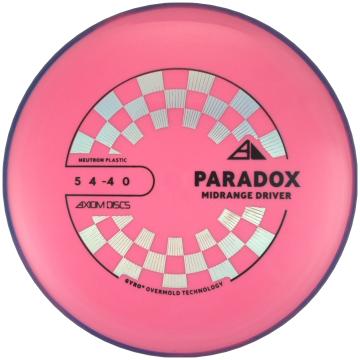
Proton Soft Paradox OTB Open Exclusive
Disc Info
HelpCondition
Markings
Product Info
Product description:
Axiom Discs Proton Soft Paradox
"Beauty is not caused. It is."
Emily Dickinson
If you're looking for a midrange that can't help but turn, look no further than the Paradox! Among the most understable midranges ever produced, the Paradox is capable of some truly unique lines. High-power players will be using the Paradox for utility shots like rollers, low speed flip ups, massive nose up anhyzers, and other touch shots. Low-power players will find the Paradox is a great first midrange for straight or hyzer-flip flights. Whether you're using it as a teaching tool, or a utility disc for woods golf, the Paradox's understability won't let you down. If you need it to turn, the Paradox is the disc for you!
Brand:
Axiom Discs
Axiom Discs are manufactured using the same technology and in the same factory as MVP Disc Sports’ discs. The rims of Axiom Discs' discs come in different colors, distinguishing them from MVP discs. Axiom Discs' discs are made from two different plastics, branded as the Gyro technology. The purpose of a dual-plastic disc is to shift the weight of the disc to the outer edge, increasing the amount of spin and providing a slight stability boost.
Axiom Discs' premium plastic blends include Neutron, Plasma, Proton, Eclipse, Fission, and R2-Neutron. Grippier and faster-wearing base plastics include Electron Soft, Electron, and Electron Firm.
The most popular Axiom Discs' discs include Hex, Proxy, Envy, Crave and Rhythm.
Flight Numbers
The numbers that usually appear on the top of the disc indicate the flight characteristics of the disc. The most commonly used way to tell the flight characteristics is to use four numbers: speed, glide, stability and fade.
Disc Weight
Disc golf discs usually weigh between 140 and 180 grams. The lighter the disc, the less stable it is. Conversely, the heavier the disc, the more overstable it behaves.